
Assistive Tools for Chronic Pain and Joint Instability
Assistive Tools That Help Me Support My Body Better
Some of the things that support my body most now are not particularly dramatic.
They are insoles inside my shoes. Supports around my wrists and thumbs. Knee braces. Sleeping with supports for my feet and hands, and sometimes even a back brace. Seating and positioning choices that help me remain in one place for a little longer. Small changes in where I keep things and how I complete everyday tasks.
None of these tools removes my diagnoses or makes my body predictable. They do not turn a difficult day into an easy one. What they can do is reduce some of the unnecessary strain my body would otherwise have to absorb.
It took me a long time to understand how significant that could be.
I did not always know support was available
I’ve had widespread pain and joint problems since I was a kid, decades before I was diagnosed with fibromyalgia and Hypermobility Spectrum Disorder. By the time I received those diagnoses in 2019, I had already spent a long time compensating, pushing through, and trying to make an unstable and pain-sensitive body behave as though it needed nothing different.
Many people do not learn about assistive tools until symptoms have already affected daily life for years. Even then, finding the right support can involve referrals, assessments, adjustments, and trial and error.
There can also be an emotional barrier. A brace or mobility aid is visible evidence that the body needs something. It can bring relief and grief at the same time.
Orthopedic insoles and support for my feet
My feet need more support because of joint instability, heel spurs, and osteoarthritis. Properly fitted orthopedic insoles help distribute pressure differently and support the way I stand and walk.
They do not mean that walking no longer costs energy or causes pain. But without support, my body has to work even harder to stabilize itself. The strain does not necessarily stay in the feet; it can influence the knees, hips, pelvis, and back as the rest of the body tries to compensate.
This is why professional assessment matters. A tool that helps one person may be unsuitable for another, and the fit can be as important as the item itself.
Braces and supports for unstable or painful joints
I use supports for my wrists, thumbs, and fingers, particularly when my hands are painful or numb, or when I am asking them to do more. I also use knee braces when my knees need additional support, and a back brace or pelvic belt when my back and pelvis need more stability.
These supports are not about immobilizing every joint or pretending that one item can solve a complex problem. They offer additional feedback and stability during certain activities. They may reduce how hard the surrounding muscles have to work to hold everything together.
My needs can also change. A support that helps during one task may feel unnecessary or uncomfortable during another. Supporting the body is rarely a matter of finding one permanent answer and applying it in exactly the same way every day.
Mobility aids can provide additional support
During periods of my life when my back has been particularly bad, I have used crutches or a cane. They can really help.
Using a mobility aid can provide additional stability and reduce some of the strain involved in moving around. It does not necessarily remove the pain or make walking easy, but it can make movement feel safer and more manageable.
I have not personally used a walker or wheelchair, but these can also be important forms of support. Some people use them all the time, while others use them only on particularly difficult days, for longer distances, or in situations where standing and walking would use too much energy or cause too much pain.
Using a wheelchair does not always mean that someone is unable to walk. An ambulatory wheelchair user may be able to stand or walk for a limited amount of time but still need a wheelchair to reduce pain, conserve energy, prevent symptoms from worsening, or participate more fully in daily life.
There can be complicated feelings around using mobility aids, especially when your need for them changes from one day or period to another. People may assume that if you can sometimes walk without an aid, you do not really need one. But symptoms fluctuate, and the amount of support a body needs can fluctuate with them.
Using a cane, crutches, a walker, or a wheelchair when it helps is not giving up. It is another way of responding to what the body needs at that time.
Seating, positioning, and ergonomic support
Sitting is not automatically restful when remaining in one position causes pain. The height and depth of a chair, support behind the back, the position of the arms, and whether the feet are properly supported can all affect how much effort sitting requires.
For me, changing position regularly is as important as finding a supportive position. There is no chair that makes my body comfortable indefinitely. Ergonomic support helps reduce strain; it does not remove the need to respond when my body asks for movement, rest, or a different position.
Pillows and cushions can serve a similar purpose. They can support a joint, reduce pressure, or help the body settle in a way that asks less of already tired muscles.
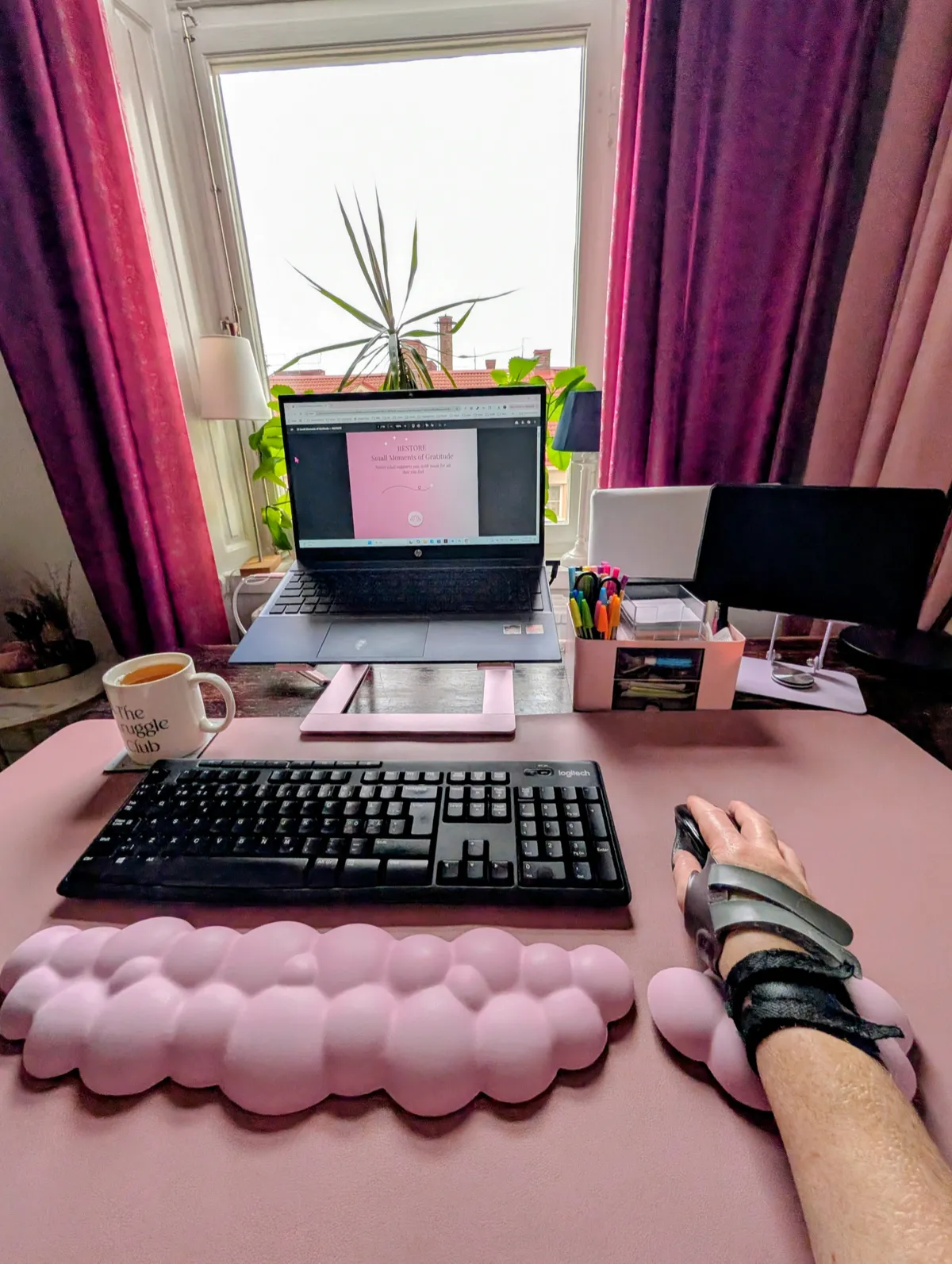
A footrest can help create a more supportive body position. Soft wrist rests in front of the keyboard or mouse may also reduce some of the strain on the wrists.
When using a laptop, having a separate keyboard and mouse can make it easier to position the screen and hands more comfortably. A compact keyboard without a numeric keypad can help keep the mouse closer, so the arm does not have to move as far to the side. A mouse that can be used with either hand can also make it possible to alternate hands instead of continually overusing one of them.
A laptop or computer stand can raise the screen so that I am looking ahead instead of continually looking down, which can help reduce strain on my neck and back. A height-adjustable desk is also incredibly useful because it allows me to change position more easily.
One of my favorite options is a standing chair or leaning stool. It helps me remain more upright while still giving my body support.
None of these things creates one perfect working position. What they give me is more choice and the ability to adjust my setup as my body’s needs change.
Supporting the body while sleeping
The type of bed, mattress, and pillow we use can also affect how much support the body receives during the night. A mattress that is too soft or too firm, or a pillow that does not support the head and neck well, can leave the body working to stabilize itself even while we are trying to rest.
Pillows can also be used to support different parts of the body. Placing a pillow between the knees or legs may help support the hips, pelvis, and lower back. A pillow between the hands or arms can reduce pressure and help prevent the shoulders, wrists, or fingers from settling into uncomfortable positions. Some people may also benefit from support underneath their knees, behind their back, or wherever their body needs a little more stability.
I sometimes sleep with supports for my feet and hands, and occasionally with a back brace. These can help keep my body in a more supported position when I am asleep and not consciously adjusting how I am lying.
There is no single sleeping position, mattress, or pillow that will suit everyone. Finding what helps may involve experimenting with different levels of support and adjusting them as the body’s needs change. Even then, supportive positioning does not guarantee a pain-free night or restful sleep. It can simply reduce some of the strain the body might otherwise experience.
Everyday tools and placement matter too
Not every assistive tool looks medical. A reaching tool or grabber can make it possible to pick something up or reach a shelf without as much bending, stretching, or climbing. Jar and bottle openers can reduce the grip strength needed, while adapted knives with larger, angled, or easier-to-hold handles can make preparing food more manageable when the hands are painful, numb, or weak.
Other household supports might include easy-grip utensils, an electric can opener, a lightweight household item, a supportive handle, a trolley, or a stool in the kitchen. The most useful tool is not necessarily the most specialized one. It is the one that reduces a repeated point of strain for the person using it.
Sometimes the most useful change is not buying something new. It is moving an item closer, keeping duplicates where they are needed, or arranging a space so that one task does not require repeated bending, reaching, or walking back and forth.
These changes are easy to dismiss because they seem too small to matter. But when the body is already using energy to manage pain, instability, sensory input, and fatigue, preventing a little extra strain can be meaningful.
Support does not take away independence
We often talk about independence as though it means doing everything without help, equipment, or accommodation. That definition leaves very little room for the reality of human bodies.
A support does not do the whole task for me. It helps my body use less effort while I do it. In some situations, that may allow me to continue an activity for longer. In others, it may mean I have slightly less pain or fatigue afterward. Sometimes it simply makes the task feel safer.
There is no moral value in completing something with more strain than necessary.
Finding the right support is personal
This is not a list of tools everyone with chronic pain should buy. Bodies, diagnoses, symptoms, and circumstances differ. Braces that help one kind of instability may aggravate another problem. Compression can feel supportive for one person and intolerable for someone with sensory sensitivity. An ergonomic setup still needs to fit the individual using it.
When possible, advice from an occupational therapist, physical therapist, orthopedic technician, or another qualified professional can help identify what needs support and how to use a tool safely.
The wider invitation is simply to question the assumption that your body should manage everything unsupported. Needing support is not evidence that you have stopped trying. It may be evidence that you are beginning to work with your body instead of continually asking it to compensate.
A gentle next step
If you are beginning to notice where your body uses the most effort, The 7 Day Gentle Energy Check-In can help you observe those patterns without turning your days into another demanding tracking project.7 DAY GENTLE ENERGY CHECK-IN